
Dewey Projected and Actual Release
A projected release date is a sentence-administration estimate. It is not the timestamp showing that a person left custody. ODOC builds a state-prison calculation from the judgment, reception date, credited time, concurrent or consecutive sentence structure, earned credits, misconduct adjustments, and later legal events. Dewey County Jail uses the local judgment and its own custody records for a county sentence. One agency's calculation should never be applied to the other agency's booking.
Actual release is the closing custody event. It may show release to the community, transfer to ODOC, movement to another county, or delivery to a federal authority. Transfer closes the Dewey booking but continues custody. Ask for the release authority and destination, not just the date.
A pretrial detainee has no sentence-based release date. Bond, recognizance, dismissal, a new order, or a separate hold may determine what happens next. The Dewey court docket explains the legal authority, while the jail transaction proves when the person physically left or transferred.
Find a Dewey Projected Release Date
Classify the custody episode first. The Dewey County release-search path separates local jail custody from a state-prison transfer. ODOC's public search is statewide and does not replace the Dewey County Jail record. Likewise, the sheriff cannot calculate an ODOC sentence after state reception.
- For a Dewey County jail case, search the OSCN docket and read the filed judgment and sentence, including awarded jail credit.
- Call DCSO at (580) 328-5558. Ask what scheduled or actual release information may lawfully be provided and whether another hold exists.
- If DCSO reports an ODOC transfer, open the ODOC offender search and match the ODOC number, aliases, court, case, offense, and status.
- Record the precise field label and date checked. A visible projection can change or be omitted.
- For an exact future state-prison date, follow ODOC's authorized channel. The inmate receives days remaining monthly and may ask records staff or a case manager for help.
- Confirm the eventual event through the jail release transaction or ODOC status and discharge record.
The public ODOC result can expose identity, status or location, offense and sentence details, and custody or supervision history. A discharged result can confirm that an ODOC episode ended. It does not prove what happened during an earlier Dewey jail booking.
ODOC's search begins with a liability notice describing its information as abbreviated and possibly incomplete. Accepting that notice opens a broader state search that may use name, identifiers, appearance, facility, or sentence facts. A Dewey County case number can help separate common-name records because public details may include the court, conviction date, term codes, statute, and CRF number. Still, an empty ODOC result may simply mean the whole custody episode stayed local.
The ODOC search interface shown here is the official state lookup named in the manifest.
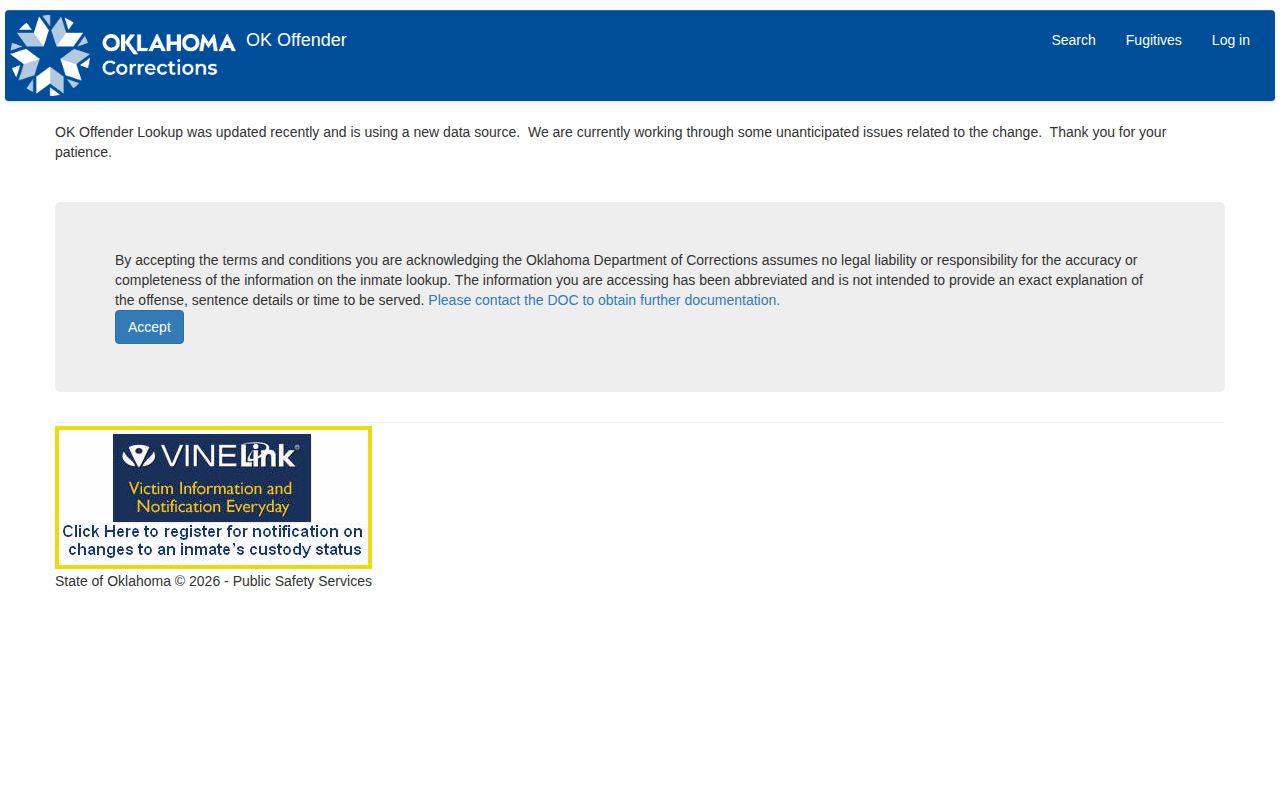
Its live field labels and disclaimer should be read each time because the displayed data can change.
Oklahoma Computes State Release Dates
ODOC's official sentence-credit paper describes a monthly balance. At reception, the prison term in the judgment is combined with the reception date and converted into days remaining. Each month, ODOC subtracts days served and credits that lawfully apply. It adds back lost credits or makes other authorized adjustments. Discharge occurs when the balance reaches zero. Pre-sentence Dewey County jail credit depends on the judge and sentencing papers.
Under 57 O.S. § 138, earned credits depend on classification and governing rules. Official material lists monthly amounts of zero at Level 1, 22 at Level 2, 33 at Level 3, 44 at Level 4, 45 at Enhanced Level 3, and 60 at Enhanced Level 4. One authorized credit equals one day. Placement and promotion depend on conduct, adjustment, approved work or programs, evaluations, and time at a level. Achievement and meritorious credits may also apply, while discipline may cause loss.
These figures explain ODOC's method. They are not a personal calculator. Future class changes, restored or lost credit, corrected jail credit, another sentence, or a court order can alter the balance. County-jail sentences must not be run through this prison table without official authority.
ODOC also describes rough projection factors for explaining how credit levels affect time. Those factors omit future misconduct, achievement credits, court changes, jail-credit corrections, parole, detainers, and new sentences. Multiplying a sentence by a factor and publishing the result would conflict with the agency's warning that a personal date is both tentative and restricted. Use the method to understand movement, not to manufacture a deadline.
Note: ODOC's projection factors are explanatory estimates, not a sound basis for publishing a personal calendar date.
Why Dewey Release Dates Change
A projection changes when its inputs change. Some events affect the sentence balance. Others affect whether a person may leave on the expected day. A detainer can cause custody to pass to another agency even if the first sentence reaches its end.
| Factor | Possible effect | Best record |
|---|---|---|
| Earned-credit level | Changes the credit rate | ODOC calculation |
| Misconduct or restoration | Removes or restores credits | ODOC records |
| Jail-credit correction | Changes recognized time served | Judgment and audit |
| Concurrent or consecutive case | Changes how terms run | Judgments and ODOC calculation |
| Parole action | May create a conditional path | PPB result and ODOC status |
| Warrant or detainer | Can delay release or transfer custody | Holding and receiving agencies |
| Sentence modification | Changes the term | Filed court order |
Capture the field label, source, and check date. That simple record keeps an old estimate from being mistaken for a current promise.
Dewey State Release Date Limits
ODOC's Offender Info FAQ says a particular inmate's exact release date is confidential to an ordinary inquirer unless there is a legitimate judicial or law-enforcement need. The inmate receives days remaining each month, may seek help from facility records staff or a case manager, and may choose to share the date. The agency also warns that any date remains tentative.
Other ODOC material still uses “Projected Release Date” as an operational term. Its Section 06 attachment index lists a form by that name. The facts fit together: ODOC calculates a date, but public display and disclosure can be limited, and the calculation can move.
ODOC policy also points users to Offender Lookup for items that can include offense, projected release date, and photo. That statement establishes the concept and possible field, but it does not override the FAQ. A live result may omit the date or show a projection that later changes. Preserve the label exactly, including words such as “projected” or “tentative.”
The manifest screenshot below captures the ODOC confidentiality and tentative-date guidance.
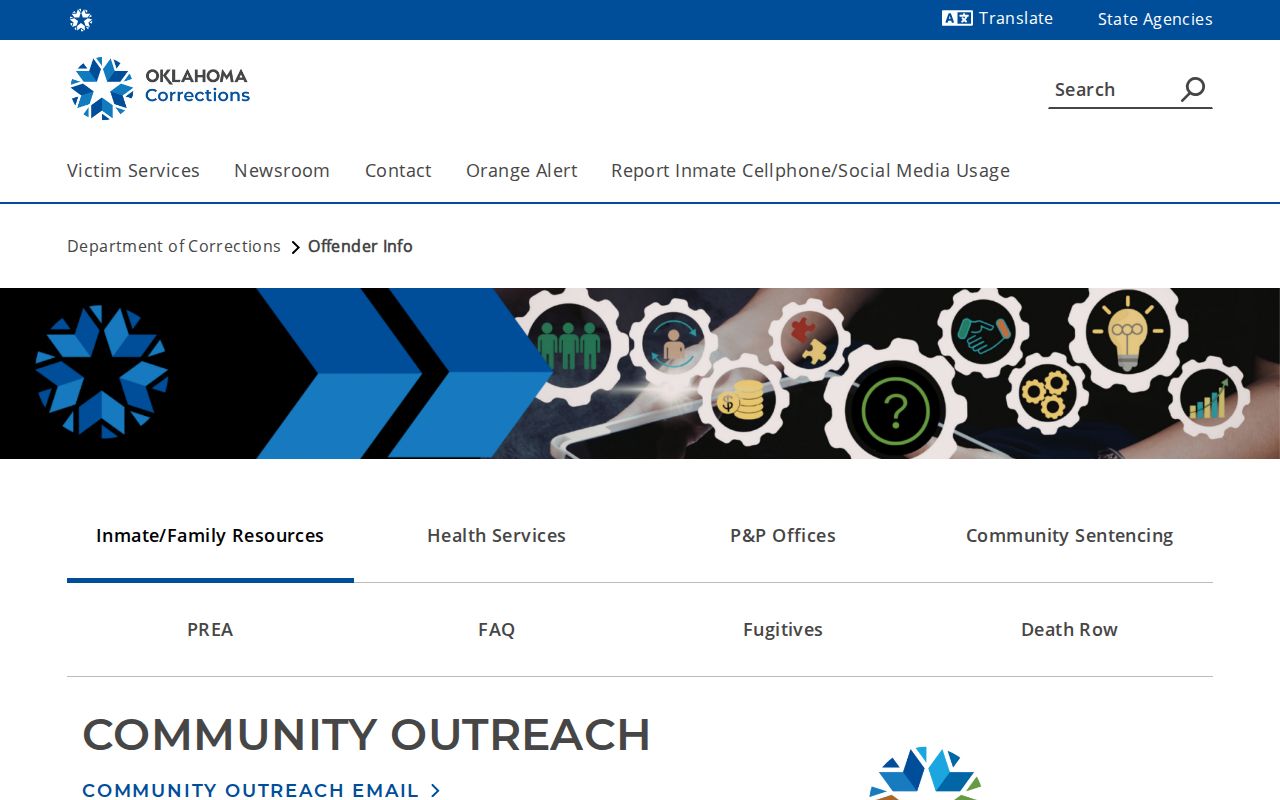
That guidance controls how a public estimate is described, even when another ODOC page names the projected-date field.
ODOC's Release Projection Worksheet
OP-060203 Attachment A is headed “PROJECTED RELEASE DATE.” It provides spaces for several future projection points across Levels 1 through 4, Enhanced Levels 3 and 4, and listed Ekstrand categories. It also separates standard security from several community or electronic-monitoring contexts.
Most important, the worksheet says its projection method does not apply to restricted-earned-credit sentences. That warning blocks a one-size-fits-all estimate. The exact conviction statute, offense date, sentence structure, credit class, and later changes must be known before ODOC can administer the term.
The form carries spaces for projections several months ahead and distinguishes security or community-supervision contexts. Those spaces show that staff recalculate a balance over time. They do not turn the worksheet into a public release calendar. A current state record, an authorized ODOC response, or the inmate's voluntary disclosure remains necessary for a person-specific date.
The official Section 06 index shown here links the projected-release-date attachment.
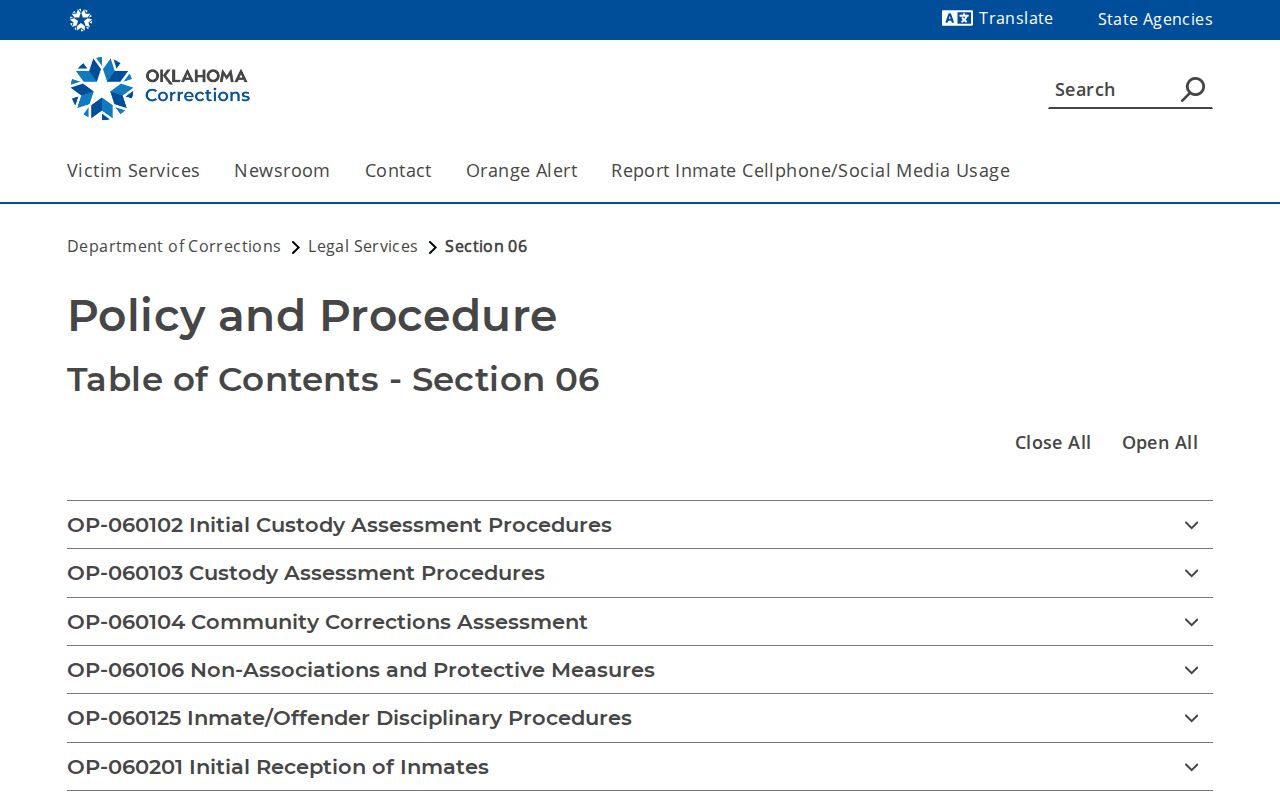
This agency worksheet explains the computation without exposing personal data. It is not a promise about one inmate.
Dewey Sentences and the 85% Rule
21 O.S. § 13.1 applies a statutory minimum to enumerated serious offenses and relevant effective dates. It does not mean every Oklahoma prisoner serves exactly 85 percent. Credits may accrue during the restricted period, but they cannot reduce confinement below the statutory floor in a covered case. Parole consideration also cannot occur before the applicable minimum.
Start with the precise conviction statute and offense date in the Dewey County judgment. Do not use an offense nickname. Amendments and other offense-specific limits matter. Parole eligibility, a projected discharge date, a mandatory release point, and actual departure are separate concepts.
A parole docket adds another estimate, not a guaranteed exit. The Board can deny, pass, recommend, or grant according to the case. Even after favorable action, ODOC may need a signed certificate, valid home offer, completed stipulations, and a warrant or detainer check. “Parole to a consecutive case” means the next sentence can begin while custody continues.
Confirm Dewey County Release Dates
For a local jail episode, DCSO's closing booking transaction is the best proof of the actual time, authority, and destination if those fields are maintained and public. The court order explains why release was authorized, but it may precede processing or be blocked by another hold. For state prison, ODOC's later status or discharge record confirms the transition.
If sources conflict, resolve the custody episode instead of averaging dates. The Dewey jail record controls its own departure, the court controls its filed order, and ODOC controls reception, credits, and state discharge. Note which agency produced each date and what that date means. A court order date, transfer date, projected date, parole date, and actual release time can all differ without any record being a simple duplicate.
A VINELink Release Check can provide a source-fed alert for release or transfer. Use it as prompt notice, then confirm with the agency named in the result. VINELink does not cover ordinary federal prison records, and silence is not evidence that nothing changed.
The sound evidence chain is judgment and jail credit, DCSO custody or transfer record, ODOC reception and sentence administration, PPB action when relevant, and the final jail or ODOC release record. Arithmetic alone never closes that chain.