
Dewey County Release Records
A Dewey County jail release record closes one local custody episode. It can show when the booking ended, why it ended, and whether another agency received the person. The Dewey County Sheriff's Office, or DCSO, is the operator and records source for the county jail. Research located no official public jail roster, release archive, or booking gallery. That makes direct confirmation and a focused request the main local route, not a backup of last resort.
Words on the record matter. Bond means the court authorized release under bond terms. Recognizance, often shortened to OR, is release on a promise and conditions without a cash bond in that case. Time served links sentence credit to the custody end. A dismissal may support release, but another hold can keep the person confined. Parole is conditional release from a state sentence under supervision. Probation is a sentence or supervision status and does not establish the hour a jail door opened. Transfer means custody went on elsewhere.
- Discharge
- The recorded end of a custody or sentence status.
- Detainer
- A request or hold tied to another authority and possible transfer.
- Time served
- Credit that satisfies the custody term ordered in the case.
- Expungement
- A court process that can seal or limit public access to qualifying records.
Dewey County Release Types
The same closed booking can lead to very different places. A community release ends physical jail custody. A transfer only changes the custodian. DCSO's release authority and destination fields, if kept, are therefore more useful than a simple answer that the person is “not here.” Read the event with the related court order and the receiving agency's record.
| Recorded outcome | Meaning | Next source |
|---|---|---|
| Bond or recognizance | Community release under court terms | DCSO release record and court order |
| Time served or sentence end | Local term was satisfied | Jail timestamp and judgment |
| Dismissal | One case ended, subject to other holds | Filed court order and DCSO record |
| ODOC transfer | State custody continued | Oklahoma offender lookup |
| Other county or federal transfer | Custody continued with another agency | Receiving jail, BOP, ICE, or court |
| Parole or probation | Community supervision may follow | ODOC status and supervision office |
Note: A transfer closes the Dewey County booking but does not show that the person entered the community.
Dewey County Release Record Fields
Ask for enough detail to identify both the person and the exact admission. A common name alone can produce a namesake error. Use the full legal name, a booking number when known, and an approximate booking date. Date of birth may help when it can lawfully be shared. The request should also distinguish the jail record from the court file. The jail owns the operational departure record. The Court Clerk keeps the judge's filed order.
| Field to request | What it can establish |
|---|---|
| Legal name and identifiers | Matches the record to the right person |
| Booking number | Separates one admission from another |
| Booking date and time | Marks the start of the local episode |
| Associated charges | Connects the booking with a case |
| Release date and time | Marks when DCSO closed local custody |
| Release type or authority | Explains the stated basis for closure |
| Destination or receiving agency | Distinguishes community release from transfer |
| Booking photograph | Provides the separately requested intake image, if releasable |
Oklahoma law specifically refers to jail information that includes the date or manner of discharge or escape. It does not expressly turn “description” into a right to a booking photo. Request that image as its own item and let the custodian apply current law, redactions, and any limits. Juvenile, sealed, expunged, medical, and security-sensitive material can be withheld or narrowed.
Request Dewey County Release Records
No official Dewey County online request form, fee schedule, fixed turnaround, custodian email, or verified mailing route was located. Call the Sheriff's Office first at (580) 328-5558. Confirm how to submit the request and whether electronic delivery or inspection is available. The official law-enforcement directory lists the physical office at 104 W. Ruble, Taloga, OK 73667. Do not assume that the physical address is the preferred mailing address.
- Identify the person with a full name, booking number, or date of birth when lawfully usable.
- Give an approximate admission date or an exact date range. For a broad release report, state start and end timestamps with the time zone.
- Ask for existing booking and release fields, including the date, time, authority, and destination or receiving agency if maintained.
- Request the booking image separately if it is needed, and ask for the legal basis for any redaction or denial.
- Ask for a fee estimate before copies are made. Keep the request, response, and date checked.
A concise request works best: ask for the electronic booking and release record for one named admission, then list the fields sought. An agency need not create a custom analysis that does not exist. It may provide the existing jail register, booking record, release transaction, or another record that holds the same facts. If a phone answer is limited, move to the written request rather than treating silence as proof.
Why did the name disappear? The booking may have closed, the display may have changed, data may lag, or custody may have moved. Only the underlying record identifies which event occurred.
Dewey County Release Record Law
The Oklahoma Open Records Act appears at 51 O.S. §§ 24A.1 and following. For jail release facts, 51 O.S. § 24A.8 is central. If the information is kept, its law-enforcement record list includes a prisoner's name, date and cause of commitment, committing authority, whether the commitment was criminal, a description, and the date or manner of discharge or escape. That final phrase supports a focused request for the end of a Dewey County jail episode.
The law does not force DCSO to publish a web roster or build a report it does not have. Nor does the located source establish a set Dewey retention period. Records remain subject to laws on retention, confidentiality, sealing, and redaction. Oklahoma expungement law at 22 O.S. §§ 18 and 19 may limit public access after a qualifying petition and order. A § 991(c) deferred-case update is not the same as a full arrest-record expungement. Use current official text for a case-specific question.
Note: Ask the custodian what exists and how long it is kept; do not assume a web display controls record retention.
Find Dewey County Released Inmates
Begin with the last known custody system. For a recent local arrest, DCSO is first. Ask whether the person remains held, entered the community, or went to another agency. Then request the release date, time, authority, and destination. A one-person check is narrower than a countywide list and can be easier to match. The full local process and contact are also covered on the Dewey County Jail release page.
- Call DCSO with a full legal name and booking number or date of birth if known. Ask about present disposition, not just roster presence.
- Search the Dewey County court case for bond, dismissal, plea, judgment, sentence, credit, transport, or writ entries.
- If DCSO reports an ODOC transfer, use the state offender lookup and read the current status, location, sentence, and supervision fields.
- Use OK VINE for a specific custody check and future event alerts. Confirm a reported release or transfer with the source agency.
- Use BOP for a federal prison sentence and ICE ODLS for covered immigration custody. Neither is a county release archive.
- When online paths fail, submit the focused record request. No result can reflect an alias, lag, sealed record, transfer, or a different court system.
Do not combine systems. A person whose whole custody episode ended at Dewey County Jail may never have an ODOC record. Someone sent to an Oklahoma prison is out of the county jail but still confined. A past BOP result speaks only to federal prison custody. Matching the custodian to the episode prevents the most common false conclusion.
ODOC Search for Dewey Releases
The ODOC offender lookup is the statewide source for people committed to Oklahoma corrections. It currently notes that its lookup uses a new data source and that the agency is working through issues tied to the change. Search by ODOC number when possible. A name search can be broadened with legal-name and alias variants, then narrowed with public identity details. Always open the individual record rather than trusting a short result row.
| Search item | Use | Limit |
|---|---|---|
| ODOC number | Strongest direct match | Applies only to the state system |
| Name or alias | Finds possible records | Common names need added matching |
| Appearance or demographics | Separates similar names | Use only fields the live site displays |
| Facility or status | Distinguishes confinement, supervision, or discharge | Status can change |
| Court and sentence fields | Links the result to a Dewey case | Not a certified court judgment |
The ODOC result may show number, aliases, photograph, offense and sentence data, current location or status, and custody or supervision history. Parole or probation means community supervision, not full discharge. A discharged record can confirm state-system history, but it does not replace the county jail record for an earlier local booking. ODOC also warns that an exact future release date is confidential to a general inquirer and tentative.
The live ODOC entry point shows the statewide search interface. Review it at the official offender lookup before using the captured view.
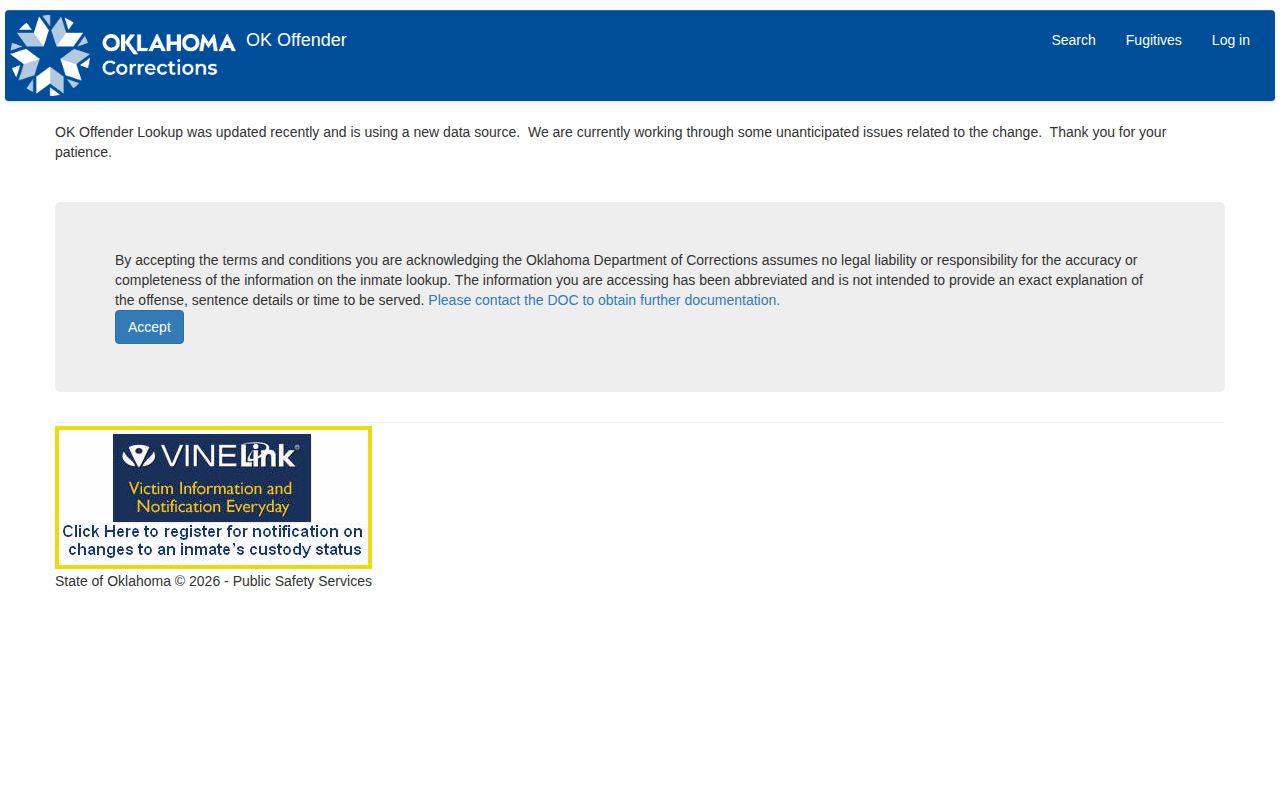
The captured interface helps identify the right state channel, while a DCSO-only booking still requires local confirmation.
Dewey County Court Release Evidence
Dewey County has two court layers that must stay separate. District criminal cases begin with the OSCN docket search. Choose Dewey County and search by case number or party name. Read the actual entries for bond, plea, judgment and sentence, dismissal, deferred sentence, revocation, and transport. “Disposed” is only a case status. It does not state when the person physically left jail, whether another hold applied, or whether custody moved.
The Dewey County service directory identifies the Court Clerk and lists (580) 328-5521. The clerk can supply a filed instrument that is not available online. The District 26 page separately confirms the Dewey prosecutor's office and its Taloga routing. A judge's order explains legal authority, while the DCSO timestamp shows execution. Those times can differ because release processing and other holds may remain. For reliable chronology, keep both records and note when each source was checked.
The official OSCN entry point shows the statewide docket search. Open the court search and complete any human verification it requests.
The docket can explain the order behind a release, but DCSO remains the source for the actual local departure record.
Note: A filed order shows legal authority; the Dewey County Jail transaction shows when that authority was carried out.
Seiling and Dewey County Releases
Seiling creates a distinct local split. The town's official law-enforcement page says it contracts law enforcement service to DCSO, yet Seiling Municipal Court remains at City Hall. A confinement or Dewey County Jail release question goes to DCSO. A municipal citation or municipal disposition question goes to the Seiling court clerk at 315 N. Main, (580) 922-4460, or court@seilingok.com.
Do not assume every Seiling police contact produced a jail booking. A citation may stay in the municipal court path. Conversely, a DCSO booking tied to a district case belongs in the Dewey County court and jail evidence chain. Match the case type before drawing any conclusion from a missing OSCN result or a municipal payment record.
The current town page shows that split in one place. Consult the Seiling law-enforcement and court source before routing the question.
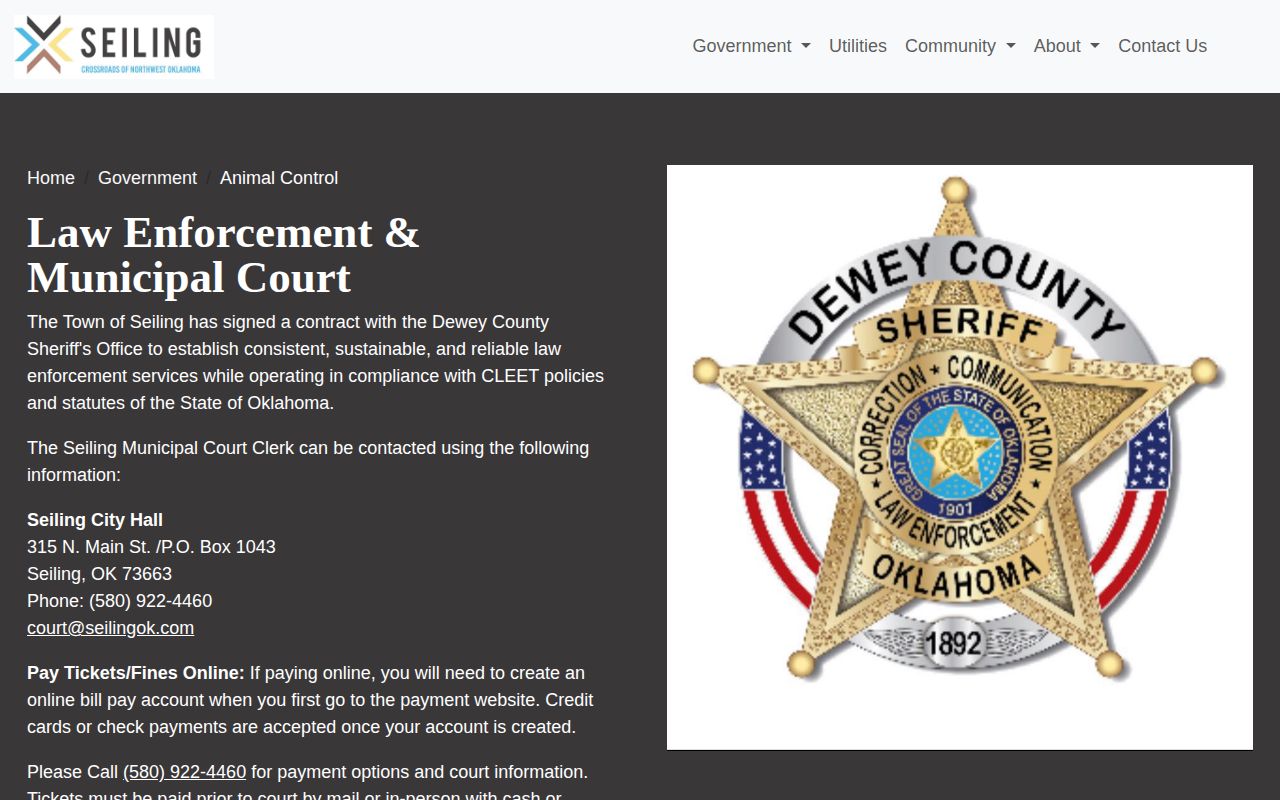
This local division explains why court and custody facts may come from different offices even when DCSO handled law enforcement.
Historic and Current Dewey Jails
Old courthouse material and historical images can mention a former jail in the Dewey County courthouse complex. They do not identify today's operating release desk, public record method, or custody policy. Current questions belong with the Dewey County Sheriff's Office at its verified W. Ruble location. The historical point is useful as a warning about stale directories, not as evidence for modern procedure.
Research did not locate the underlying National Register nomination needed to publish added historical claims with confidence. No old building is treated as a current facility here. Likewise, no separate municipal jail, ODOC prison, BOP institution, ICE center, or USMS detention site was verified inside Dewey County. Facility geography also differs from court geography. A Dewey case can send a person to a state or federal site outside the county.
Note: Use current agency sources for release logistics; an old jail photo cannot prove where records or releases are handled now.
Dewey County Release Custody Channels
OK VINE supplies source-fed custody checks and alerts. The Oklahoma Attorney General's OK VINE page describes a confidential, 24-hour service available through web, app, telephone, email, text, and TTY. Search one person, compare all returned identifiers, note the source agency and event time, then register if an option is offered. A VINE event is timely notice, not a certified discharge record. Confirm it with DCSO or ODOC.
For a federal prison sentence, use the BOP inmate locator. It covers federal inmates from 1982 onward. A result may show “Released” or “Not in BOP Custody,” but BOP warns that another authority or supervised release may still apply. ICE's Online Detainee Locator System is for covered current or recent immigration custody. A Dewey release to ICE is a transfer, not community release. The USMS prisoner information explains federal pretrial and transport custody, but USMS has no comparable public name locator. Use the federal court, district contact, and actual holding facility.
| Question | Best starting source | What a result does not prove |
|---|---|---|
| Still held at the local jail? | DCSO direct check | Roster absence does not prove release |
| How did local custody end? | DCSO booking and release record | A transfer is not freedom |
| What order governed the case? | OSCN and filed court instrument | An order is not the jail timestamp |
| In state prison or supervision? | ODOC offender lookup | No ODOC result does not resolve a local-only booking |
| Need a custody change alert? | OK VINE | An alert is not a certified record |
| Federal or ICE custody? | BOP or ICE ODLS | Ending one system's custody may not end all custody |
Special registries are narrower still. The Oklahoma sex and violent offender registry applies only to people with a statutory duty to register. Presence can continue after custody ends. It does not give the Dewey County jail release time. Absence has no general meaning and cannot resolve whether a person was booked or released.
Dewey County Release Facility
The Dewey County Jail is the only verified detention facility in the county map. DCSO operates it. It may hold people in local criminal process and for other authorities. Research found no authoritative current capacity, release-desk hours, release exit, property-pickup procedure, app, or online roster. Those details must be confirmed directly rather than filled from an old directory or another Oklahoma county's system.
A person may leave this jail for the community, ODOC, another county, treatment, federal custody, or immigration custody. Ask for the destination or receiving agency whenever the release type is unclear. Once ODOC accepts the person, the state record becomes primary for that custody episode. For BOP or ICE, use the matching federal channel. For a community release, DCSO's closing transaction and the court order form the strongest local pair.
- Dewey County Jail: county jail operated by DCSO; confirm release type and destination through the local record.